

On writing
How many words you should write per day, why the adverb is not your friend, and everything I learnt on my desert writing retreat
A novelist’s advice on:
✦ Writing routines
✦ First Drafts
✦ Style Elements
✦ Descriptions
✦ Rewrites
My luggage is overweight at CDG Airport, Paris.
A nice lady from Air France pulls me aside and suggests I stuff all the books I packed underneath my clothes.
I point at my outfit, gesturing “how?” — I’m wearing a teeny tiny skirt and a baby tee. There really isn’t a whole lot of space to “hide” a Stephen King classic and a Lena Dunham memoir under there. But I step aside and manage to (more or less) cram all my books into the waistband of my skirt.
Before getting back in line, I do a few practice rounds at Terminal 2, learning how to waddle so that all my books won't slip out from between my legs every step I take.
Then I stand in front of the Air France crew again — hunched over, with four paperbacks stuffed under my mini skirt, arms clutched to my sides to secure the Stephen King. Let’s just say it’s very much a two-kids-stacked-on-top-of-each-other-in-a-trench-coat kind of situation. You could absolutely tell I have a small library hidden under my tiny MNZ skirt. Hell, some books are even sticking out at the top.
But lo and behold — this time they weigh my carry-on, 12.3kg, and wave me through, no questions asked.
Thank you, lady.

I’ve had the urge for some undisturbed time to write for a while now. Felt like typing away on six Americanos at Paris coffee shops just wasn’t doing the trick anymore. So when I saw a slot open up, I booked my flights to Morocco and went off on my self-imposed time-out in the desert. To write and watch the bugs.
No WiFi.
No speakers.
Only my 2016 MacBook, which at this point is more like a kitchen cutting board with a Pages program.
My books.
And a 3GB eSIM plan (which I had to top up four times to watch Switzerland lose the Ice Hockey World Championship).
The goal: finish the outline for what I’ll keep referring to here as my tell-all book.
Anyway, here’s everything I learned in the desert on writing.
“Writing fiction, it’s like crossing the Atlantic Ocean in a bathtub. There’s plenty of opportunity for self-doubt.” — Stephen King
On writing
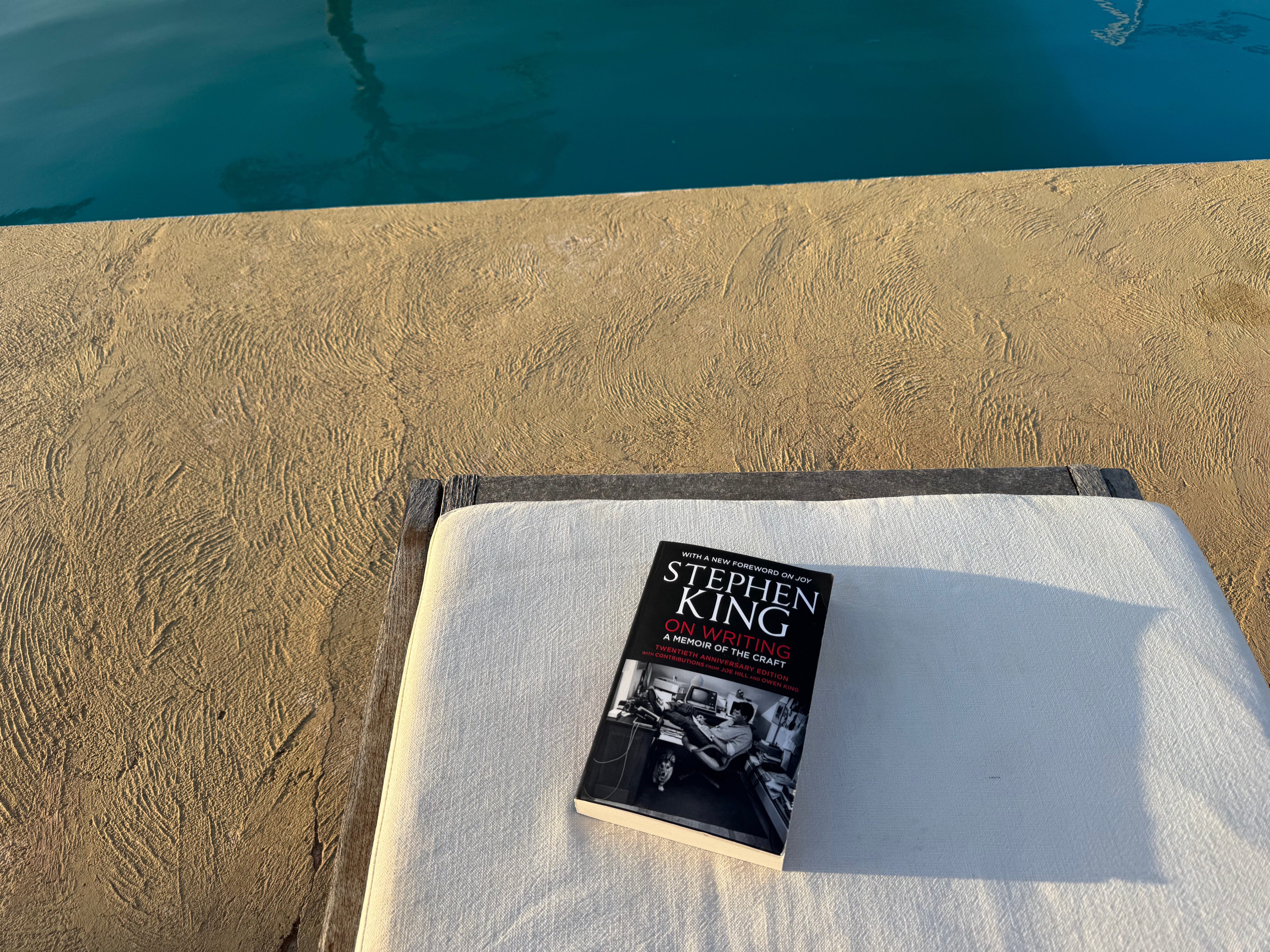
I read Stephen King's On Writing — A Memoir of the Craft (2000) in the desert. It's half autobiography, half writing advice.
You (or I) may not be a big King reader, but if there's one thing I can objectively say, it's that he's a master storyteller — he's been putting out books for over five decades (Carrie was published in 1974), and readers keep enjoying them. Nuff said. Lots to learn. So if you write, I'd recommend reading this book.
On Writing Routines
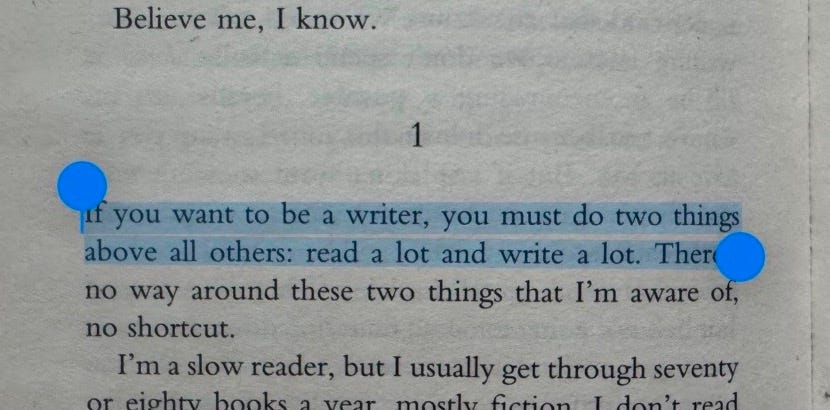
If you want to be a writer, you should read as much as you can and write as much as you can.
Your writing is essentially a muscle. It can be exercised and trained.
If you’re at the start of your writing career, you should write 1,000 words a day on your story — every day. You may take Sundays off if it’s really needed.
(King doesn't leave his desk before he's hit his 2,000 words for the day. His afternoons are usually free for other things.)
Your writing room should be private — a place where you go to dream. You check in at the same time every day and check out once you’ve put down your 1,000 words. Thereby you train your waking mind to enter dreamland — which is crucial for writing fiction.
It works like training your body and mind to fall asleep, by going to bed at the same time every day, with the same wind down routine.
“In both writing and sleeping, we learn to be physically still at the same time we are encouraging our minds to unlock from the humdrum rational thinking of our daytime lives.” — Stephen King
I remember that Murakami says the exact same thing about this writing routine:
“I keep to this routine every day without variation. The repetition itself becomes the important thing; it’s a form of mesmerism. I mesmerize myself to reach a deeper state of mind.” — Haruki Murakami
On First Drafts

King suggests writing the first draft of your story within three months, or the story might start to feel like a foreign object.
The faster you get the first draft out, the more likely you are to keep up with your original enthusiasm and outrun your own nagging voice of self-doubt that’s trying to catch up with you.
Your main job is to show up and let go of your ideas about what something is supposed to be — instead, let the story show you what it is.
(Idk this sounds so woo-woo, but this is something every fiction writer I've ever come across says)
King compares writing novels with the image of digging up a fossil — it’s been there all along, you just need to find an access and let it unfold to you.
Let the problems solve themselves. If you show up, you’ll suddenly — in the shower, driving a car, or walking around the block — get that sudden flash of insight, when you see how everything connects. “Thinking above the curve,” some call it, or “the over-logic.” It’s wild when it happens.
On Style
Avoid the passive voice!
The passive voice is when something is done to the subject of a sentence — and that’s just not as strong. We hate passive things.
This advice can also be found in the classic The Elements of Style by William Shrunk Jr., which King highly recommends (and which I'm gonna read next).
Example:
Instead of writing My first kiss will always be recalled by me as how my romance with Shayna was begun why don’t you just say: My romance with Shayna began with our first kiss. I’ll never forget it.
Done.
“The timid fellow writes: The meeting will be held at seven o’clock […]
Throw back your shoulders, stick out your chin, and put that meeting in charge! Write The meeting’s at seven. There, by God! Don’t you feel better?”
I do.
Ok next:
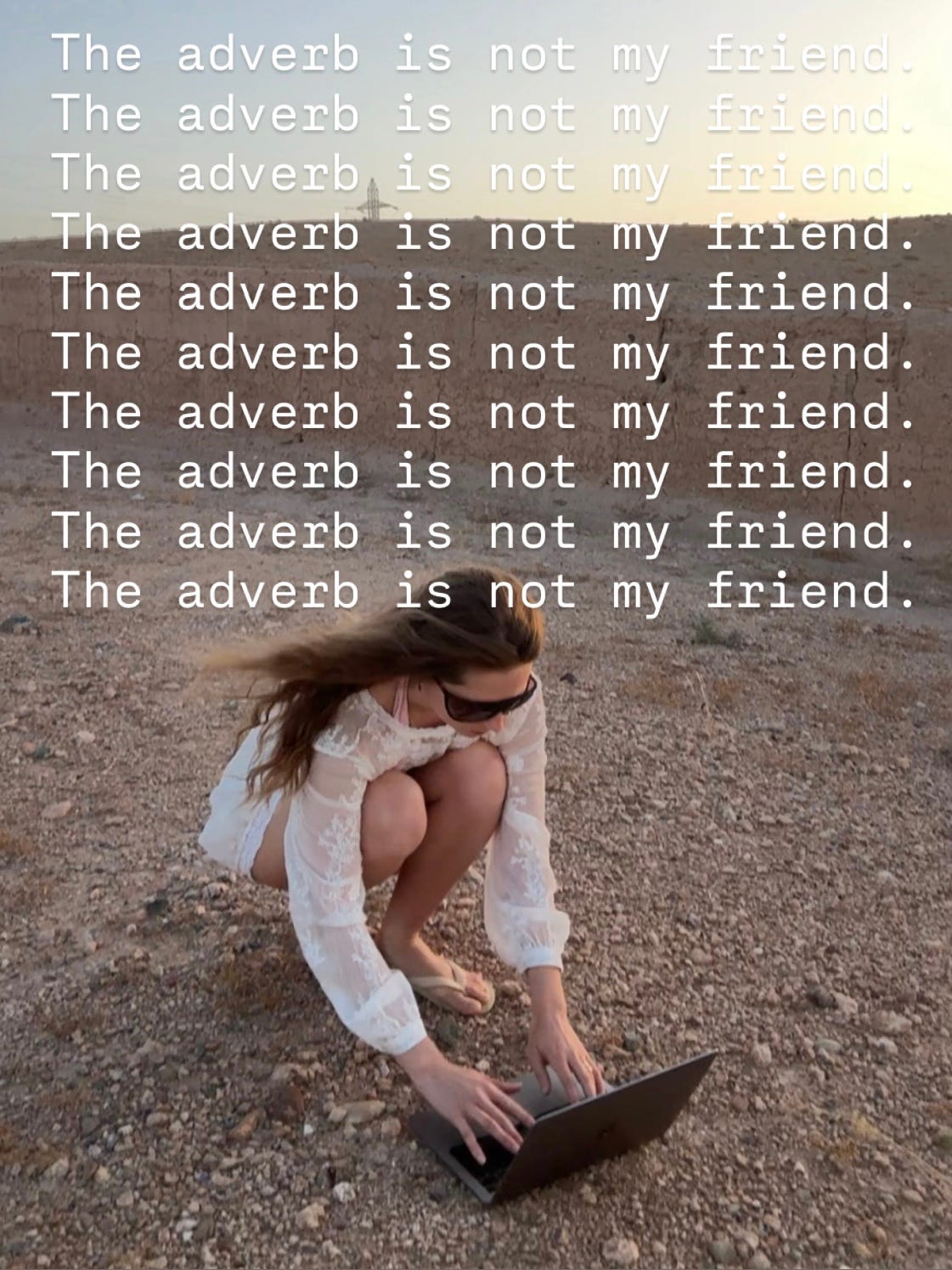
The adverb is not your friend!
In fact, the road to hell is paved with adverbs.
Example:
Instead of saying He closed the door firmly, just say He slammed the door.
And also, shouldn’t you have given enough context in the prose before, to let the reader know for themselves how he would close the door, with which emotion?
Calm down on the dialogue attribution!
‘Put it down!’ she shouted.
‘Give it back,’ he pleaded, it’s mine.’
‘Don’t be such a fool, Jekyll,’ Utterson said.
In these sentences, shouted, pleaded, and said are verbs of dialogue attribution. Now look at these:
‘Put it down!’ she shouted menacingly.
‘Give it back,’ he pleaded abjectly, ‘it’s mine.”
‘Don’t be such a fool, Jekyll,’ Utterson said contemptuously.
Don’t you start to feel like he said, she said, they said is just divine.
On Descriptions
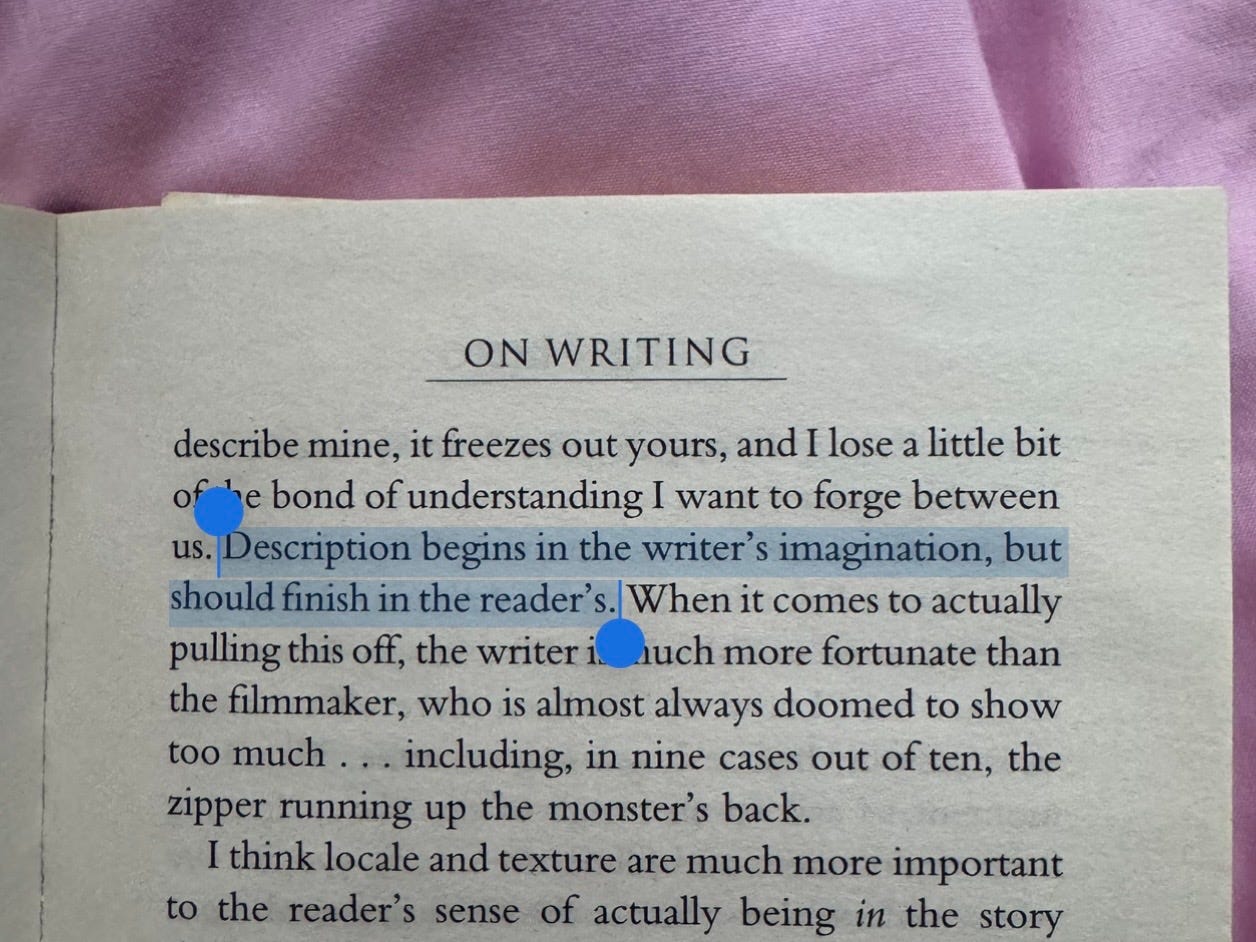
I also read Asymmetry by Lisa Halliday in the desert. In it, Ezra, a fictional world-famous novelist, says: “It’s a funny business, this. Making things up. Describing things. Describing the door someone just walked through. It’s brown, the hinges are squeaky... Who gives a shit? It’s a door.”
With description, it’s always the question: what to describe and what to leave out? Finding that balance is key.
Too little description might leave the reader confused. Too much buries them — or slows down the pace and bores them. And then it’s really, who gives a shit?
(I tend to under-describe because of my screenwriting background.)
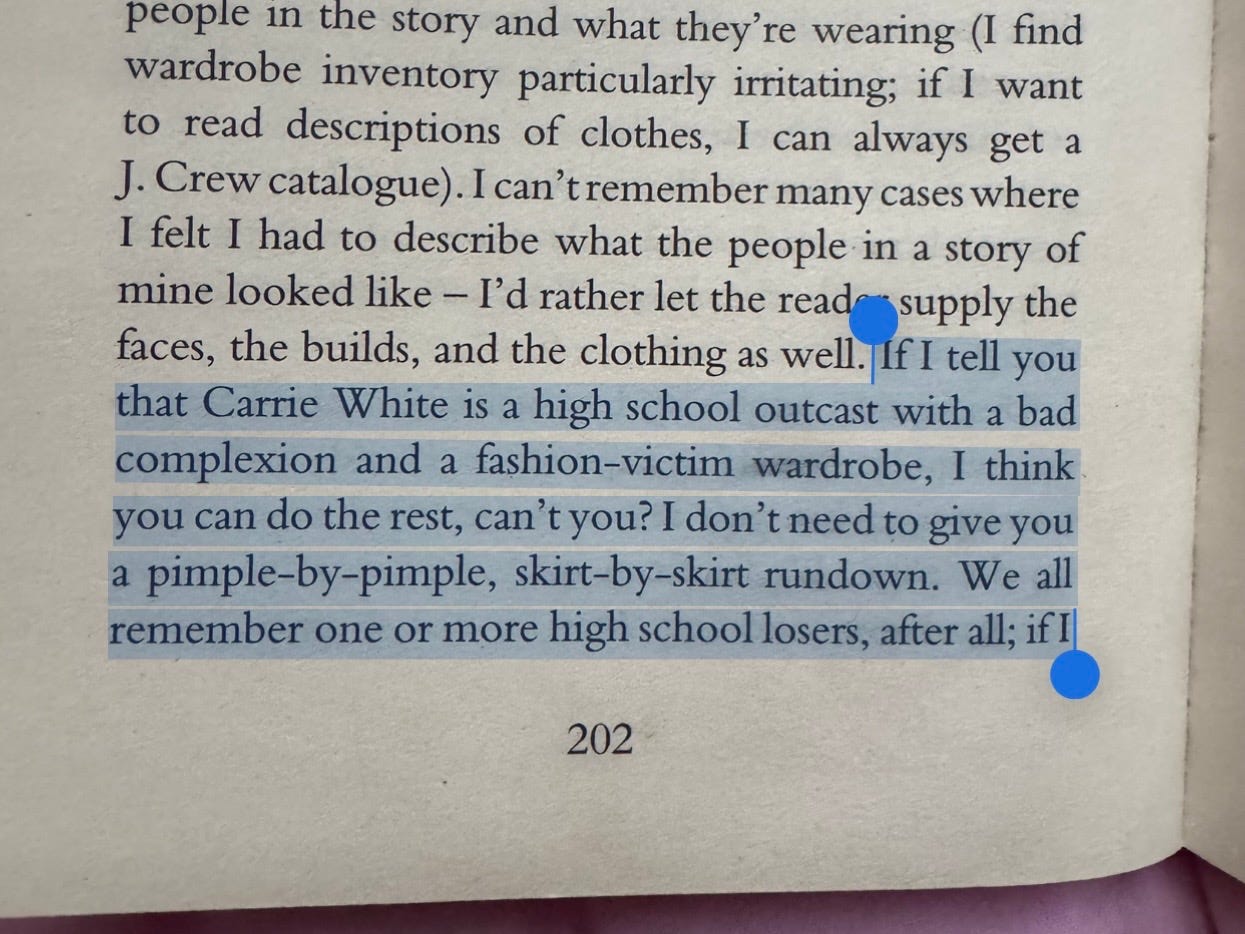
Say what you see. Take a few well-chosen details that stand in for everything else.
(King prefers location and texture over physical descriptions of characters.)
Use fresh images and clear vocabulary to describe them. Done. Get on with your main job — telling the story.
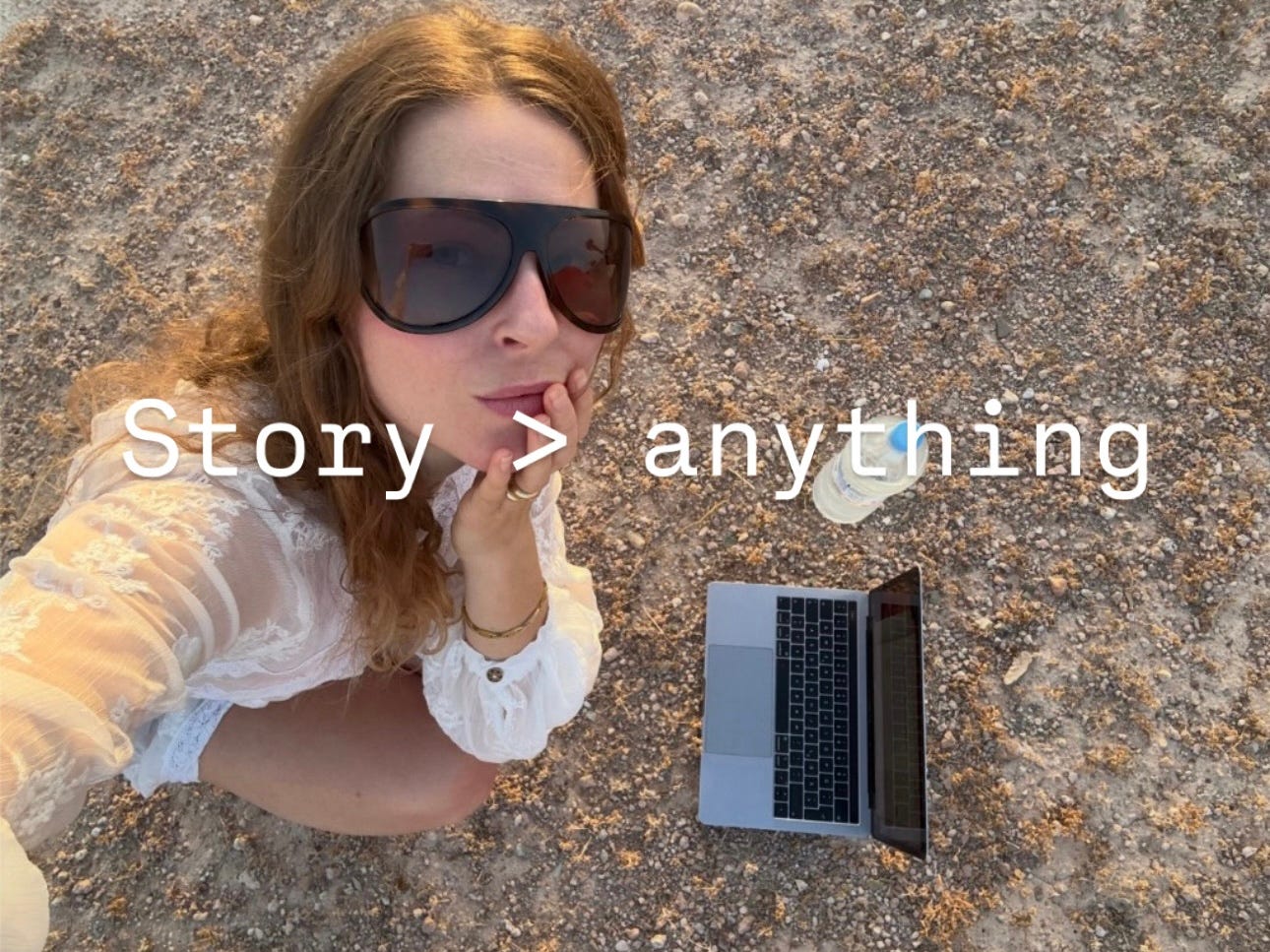
King’s very much a story > anything type of writer. And if you want to write an unputdownable book, then that’s true, I guess.
****I sometimes definitely catch myself skimming through those parts where an author has gone off on a three-page rampage describing, in impressive detail, the art of tying a fishing fly — and only clock back in once they return to the story, because I just want to know what tf will happen next (and not about the fishing fly)
On Rewrites
Write the first draft of your story with your door closed, and the second draft with the door open.
Meaning: just get the story out of your system as quickly as possible, without interference — you’ll already have enough of your own inner voice to handle, no need to bring in Uncle Donny’s just yet.
Then wait at least six weeks before you even look at that first draft again, so it can start to feel a little foreign — it’s easier to kill someone else’s darlings than your own. Start on a new project even. Then after enough time has passed, get on the rewrite and open the door to your first readers’ notes and feedback.
When you write your first draft, you spend your days scanning and identifying the trees. When you’re done, you can step back and look at the forest.
That’s all, hope this helps you as much as me.
And don’t forget to have fun on the playground!
x Alma
“When I’m writing, it’s all the playground, and the worst three hours I ever spent there were still pretty damned good.” — Stephen King
Ps: If you're the type for it, I cannot recommend fucking off to be by yourself for a few weeks enough — writing or not.
Stephen King and I are about to go on a date! Thx